
 Australia
  Canada
  Denmark
  France
  Germany
  Greece
  Ireland
  Netherlands
  New Zealand
  Norway
  Spain and Portugal
  United Kingdom
  United States
 May 13, 2026
The Association of Certified Fraud Examiners (ACFE) estimates that USD $5.5 trillion was lost to global fraud in 2026. In today’s fast-moving financial environment, the ability to trace the flow of funds has become a cornerstone of modern legal and forensic investigations. Whether the matter involves fraud, family law, commercial litigation, or corporate misconduct, funds tracing provides the evidence lawyers need to build strong, defensible cases.
What is funds tracing?
Funds tracing follows the path of money: where the money originated, how it moved, and where it ended up. It is crucial in matters involving hidden assets, misappropriated funds, or transactions designed to conceal ownership or intent.
Importantly, funds tracing is not only about uncovering wrongdoing. It also helps establish accurate financial profiles, support recovery actions, and strengthen negotiations or court proceedings by replacing assumptions with clear, data‑driven evidence.
Why it matters
Clear financial evidence can make or break a case. Funds tracing transforms raw, often disorganised records into a coherent story of behaviour and intent.
- In commercial disputes: it helps prove or refute allegations of mismanagement.
- In family law: it uncovers hidden assets or undeclared spending.
- In criminal matters: it reveals illicit gains, money laundering patterns, and financial motives.
Without proper tracing, critical evidence may remain buried in the volume and complexity of modern financial data.
How it works
Effective funds tracing begins with a clear scope and collaboration between lawyers and forensic accountants. Once the scope is defined, the financial story begins to emerge.
Below is a summary of the steps we typically follow. Not every step applies in every matter. The process is flexible and tailored to the specific circumstances.
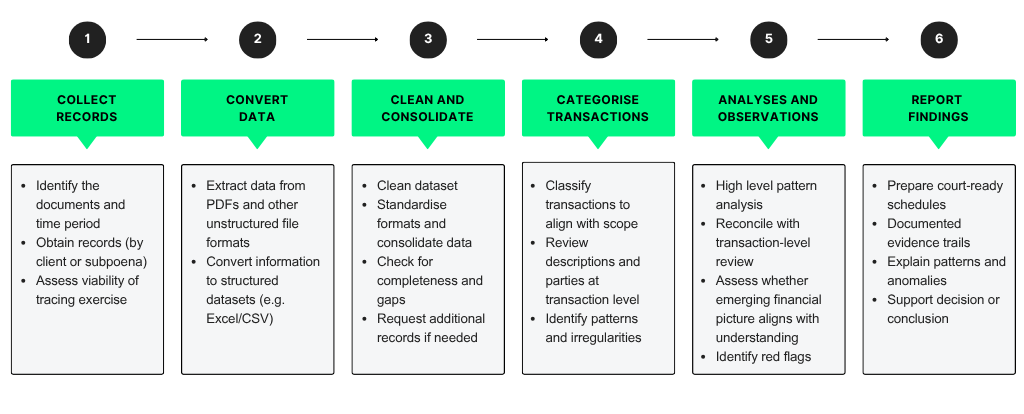
- Collect records
Tracing can be time‑consuming and costly, and the value of potential recovery should be weighed against the likely effort involved. In some matters, the true scale of the task only becomes clear after the initial documents arrive, prompting a reassessment of the proposed approach.
- Convert data
Once data is structured, it can be sorted, filtered, queried, and visualised, which is critical for identifying trends, anomalies, relationships between transactions, and potential red flags. Accurate data conversion is essential to lay the groundwork for deeper forensic analysis.
- Clean and consolidate
Proper cleaning and consolidation ensure that the dataset is accurate, comprehensive, and fit for subsequent tracing and analysis.
- Categorise transactions
By organising the data into logical categories, the flow of money becomes easier to trace. Effective categorisation provides structure to the data and creates a clear framework for analysing the movement of funds.
- Analyses and observations
Unexplained discrepancies or deviations from standard workflows may indicate areas requiring deeper scrutiny. Ultimately, this step translates raw findings into insights, helping to shape investigative hypotheses, guide further enquiries, and formulates the strategy most relevant to the case.
- Report findings
This stage also involves articulating the significance of identified patterns and anomalies in a report and explaining how they relate to the issues in dispute. A robust report not only presents the results but also demonstrates the reliability of the tracing process, enabling decision‑makers to rely on the findings with confidence.
Outlook for the future
Advancements in technology are rapidly reshaping the funds tracing process. Historically, data conversion, consolidation, and categorisation were highly labour intensive steps, but modern OCR and data‑extraction tools now streamline these tasks considerably, with some platforms even able to automatically classify transactions.
AI software can also bulk‑review and summarise supporting documentation, including emails, contracts, and narrative descriptions. This significantly reduces the manual workload traditionally associated with evidence review.
Emerging tools can automatically generate charts and transaction‑flow diagrams, allowing complex findings to be presented in a more easily accessible and digestible format for fact‑finders. As AI models are further trained for anomaly detection and pattern recognition, the time required to move from raw records to actionable insights is expected to reduce even further.
However, these tools are rarely flawless, making manual verification and expert oversight essential to ensure accuracy and defensibility. Human judgement remains critical to validate output, resolve discrepancies and interpret ambiguous information that technology cannot always capture. Expert review strengthens the reliability of the funds tracing process and findings.
As the technology matures, the combination of human expertise and intelligent automation is expected to transform funds tracing from a predominantly reactive exercise into a more proactive tool for early intervention and risk management.
Red flags to watch
Based on our experience, some of the most common warning signs in funds‑tracing matters include:
- Large or round-sum transactions: High‑value or round‑number transfers, particularly when occurring frequently or outside normal activity patterns, may indicate that funds are being funnelled elsewhere and should prompt further inquiry.
- Different suppliers using the same bank account: Multiple payees sharing the same underlying account may signal an attempt to disguise payments as legitimate business expenses when they are ultimately paid to the same individual or entity.
- Frequent cash withdrawals or luxury purchases: Cash activity or high‑value spending inconsistent with income may indicate lifestyle inflation, financial pressure, or behaviours such as gambling that may be relevant to the matter.
- Inter-account transfers obscuring the audit trail: Rapid or layered movements between related accounts can be used to maintain certain balances or complicate the trail, enabling misconduct to continue undetected.
How Sedgwick helps
From thousands of transactions, we uncover the financial narrative – where money came from, where it went and who ultimately benefited. In a world where transactions are instantaneous and increasingly complex, tracing requires specialist expertise and robust methodologies.
At Sedgwick, our forensic accounting team has the expertise to navigate these challenges. As one of Australia’s largest groups of forensic accountants, we support insurers, corporates and legal clients with accurate, comprehensive funds tracing. Beyond tracing, our specialists work across a wide range of specialty insurance claims and general litigation, ensuring clarity, accuracy and trusted outcomes in complex situations. Our expertise supports legal teams, insurers, and corporates in asset recovery, fraud investigations, and litigation. With Sedgwick, you gain evidence that strengthens strategy and drives successful outcomes.
If you would like to learn more about how Sedgwick can support you with funds tracing or other forensic services, please contact [email protected] or [email protected]