 Australia
  Canada
  Denmark
  France
  Ireland
  Netherlands
  New Zealand
  Norway
  Spain and Portugal
  United Kingdom
  United States
Catastrophe, property, material and labor cost: navigating a new era of risk
Catastrophe risk, property exposures, material shortages and labor costs aren’t isolated challenges anymore — they’re converging into a constant, high-stakes reality.
For 2026 and beyond, the risk and claims landscape demands more than awareness. It calls for action. Climate volatility, unpredictable weather and geopolitical shifts are rewriting the rules; the era of “wait and see” is over.
Labor shortages and immigration disruptions are driving up costs and stretching timelines. At the same time, material supply constraints and shifting trade dynamics are adding new layers of complexity. Technology and AI offer powerful solutions — but legacy systems and the need for specialized expertise can slow momentum.

In this environment, boldness wins. Agility, proactive planning, and investment in both technology and people aren’t optional — they’re essential. The organizations that adapt to shifting risk profiles and anticipate regulatory and geopolitical change won’t just manage disruption — they’ll lead the way, delivering consistent, high-quality service in the face of uncertainty.
Catastrophe risk becomes baseline planning
Three-quarters of organizations expect at least moderate insurance and claims challenges driven by catastrophe risks in the next 1–2 years, with assessment frequency tightening across industries. The shift toward more frequent assessments signals that catastrophe risk is no longer treated as a periodic concern but as an ongoing operational reality requiring continuous monitoring and rapid response capabilities.

76%
Expect CAT challenges
Moderate to severe insurance pressure anticipated
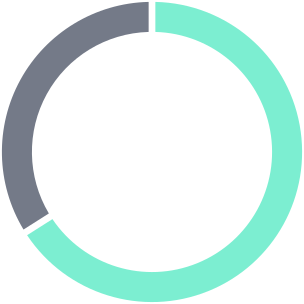
66%
Assess annually
Conduct property catastrophe evaluations yearly or more

Assessment frequency breakdown
53% conduct annual catastrophe assessments
13% assess twice yearly or more frequently
54% expect moderate insurance challenges
20% anticipate significant challenges
2% foresee severe catastrophe impacts
Labor access and immigration impact
Immigration-related labor disruptions affect three-quarters of organizations to varying degrees, representing a chronic operational drag rather than an acute crisis. Technology, hospitality and healthcare sectors report the highest exposure, with moderate hindrance levels suggesting persistent rather than severe constraints.
Experience labor friction
Some degree of immigration-related access hindrance
Moderately hindered
Noticeable but manageable workforce constraints
Significantly strained
Critical or severe labor access challenges
This sustained pressure on labor availability influences incident rates, training continuity and operational risk profiles across affected industries, particularly in roles requiring specialized skills or high physical presence.

Sedgwick leader perspective
Embrace complexity, deliver results.
The convergence of catastrophe risk, labor and material shortages, geopolitical volatility and technology challenges is rewriting the rules of risk and claims. At Sedgwick, we see this as a call to action: success in 2026 will demand relentless planning, rapid adaptation and investment in both talent and technology.
The future belongs to those who embrace complexity, break through legacy barriers and turn disruption into opportunity — setting a new standard for resilience and service in an unpredictable world.
The shift toward more frequent assessment tells us that catastrophe risk is no longer treated as an occasional concern. It’s now an ongoing operational reality requiring continuous monitoring and rapid response capabilities.”
— Paul White, CEO, International

01
Catastrophe risk is now an unrelenting reality.
Organizations must shift from periodic planning to constant vigilance and rapid response.
02
Labor and material shortages are reshaping costs and timelines.
Global disruptions and immigration shifts are driving up expenses and delaying claims resolution.
03
Geopolitical volatility and trade barriers demand new agility.
Business operations and claims servicing are increasingly impacted by global tensions and shifting policies.
04
Legacy technology is the biggest obstacle to transformation.
Breaking through tech debt is essential — AI will revolutionize claims, but only for those who modernize and invest in expertise.

In property claims, there’s a physical barrier that technology can’t erase. High-end expertise will always be needed, even as automation reshapes the lower end.”
— Scott Richardson, President Property Americas