
 Australia
  Canada
  Denmark
  France
  Germany
  Greece
  Ireland
  Netherlands
  New Zealand
  Norway
  Spain and Portugal
  United Kingdom
  United States
 April 21, 2026
Most employees will require leave under the Family and Medical Leave Act (FMLA) at some point during their employment. Although each circumstance is unique, certain recurring questions arise that don’t have straightforward answers. These real-world scenarios can present challenges for both employees requesting leave and employers determining their obligations and next steps. This article examines several common situations and discusses how FMLA may apply. As a reminder, specific circumstances should be reviewed with legal counsel. This article is intended to provide general informational guidance only.
Incarceration
Incarceration or jail of an employee with an approved FMLA leave poses a great question: is their time covered while in jail? Certainly, if an employee is incarcerated, then they can no longer care for a family member or bond with their child; those leaves should be paused while the employee remains incarcerated.
But what about the employee’s own serious health condition? You may be unsurprised to learn that there’s no definitive answer when it comes to the employee’s own serious health condition. Lower courts are split. For example, one court held that an employee remained eligible for benefits while in jail as long as he still had entitlement left.[i] Another court landed on a different outcome. Because the employer held the honest belief that the employee was misusing FMLA by claiming days that coincided with jail or court dates, their termination did not rise to the level of retaliation or interference.[ii]
Because there is no definitive answer, this may be a good one to review with legal counsel before choosing how to handle an employee on leave for their own serious health condition while incarcerated. For some employers, it may make sense to decrement the time to use up their entitlement. For other employers, they may want a different outcome. Whatever the choice, make sure to apply it to all similarly-situated employees going forward.
Foster to adoption bonding
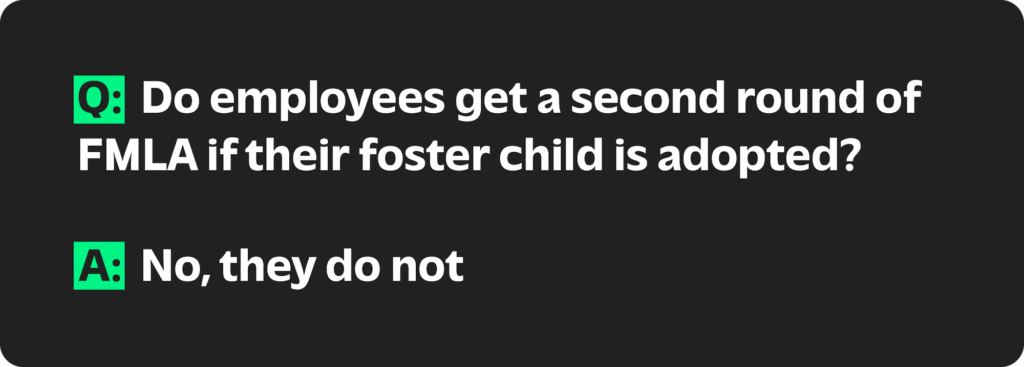
This is a common question: do employees get a second round of FMLA entitlement for adoption bonding if their foster child is adopted? The simple answer is no. The law states that the entitlement to bond with a foster or adopted child expires 12 months after the child is placed.[iii] Additionally, FMLA regulations are clear that the 12-week period of bonding for foster or adoption is for a newly placed child.[iv] If an employee is fostering a child, then it is helpful to explain to them they will have one 12-week bank of leave to use 12 months after their child is placed. Explaining that they will not have another 12-week leave if the child is eventually adopted can help prevent confusion later.
Surrogacy
Surrogacy can seem like a tangled mess, but when unraveled, it’s not as hard as it may seem. In a surrogacy, there is an individual who is carrying the child (the surrogate) and one or two intended parents. The surrogate will have a pregnancy disability claim and entitled to FMLA as long as their disability is certified by the health care provider. The intended parents will be able to take FMLA leave for baby bonding. The converse is also true: the surrogate will not be able to take FMLA for baby bonding and the intended parents will not have a claim for pregnancy disability.
State laws may not be the same and each surrogacy agreement may be different. Any questions on specific situations should be reviewed by your legal counsel.
Travel for appointments
Your employee submitted their certification and is approved for appointments. But the provider’s office is an hour away from your workplace. Is that time covered under FMLA?
The DOL provided much needed guidance on the treatment of travel time for medical appointments in FMLA2026-2. The DOL concluded that travel time related to the employee or family member’s serious health condition is covered and should be decremented from the employee’s entitlement. From a practical standpoint, this makes a lot of sense. It also matches earlier case law that touched on travel and FMLA.[v]
The letter points out that health care providers can only provide certification on their expertise, which is the serious health condition they are treating. The health care provider cannot and should not be required to provide an estimate for travel time. The travel time will not be captured on your employee’s certification form. This will need to come directly from your employee. You may want to add a question to your claim intake process to ask about travel time to appointments or ask employees who have certified appointment time the location of the appointments.
The opinion letter has four examples to show how travel time is associated with the serious health condition and examples where time is used outside of FMLA. The examples show that travel time to and from an appointment, along with any time spent waiting for the appointment, are covered. The examples also explain stops along the way or travelling with a family member who doesn’t need assistance due to their serious health condition are not covered.
Caring for spouse while working for the same employer
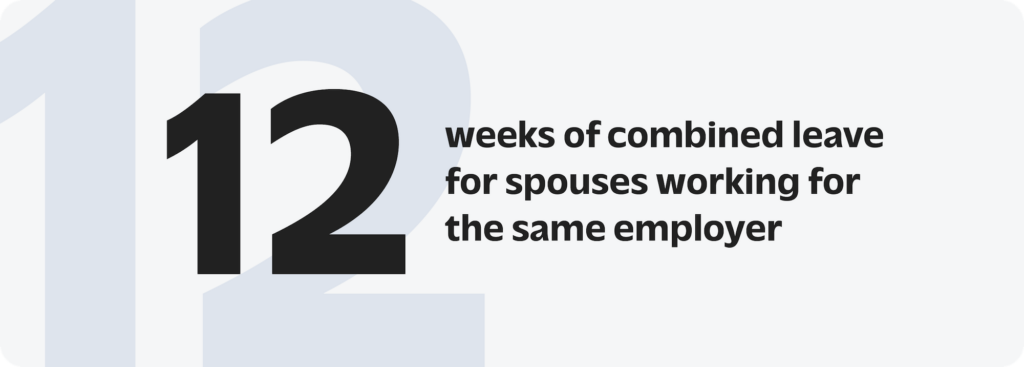
Employees who need to take time to care for their spouse is covered under FMLA. If spouses work for the same employer, they may be required to share a combined total of 12 weeks of leave during any 12-month period if they need leave to care for their parent with a serious health condition or for bonding.[vi] They do not need to share their 12 week entitlement in this situation where one employee is caring for their employee-spouse, also on FMLA leave.
If you need to care for your spouse, don’t do what the plaintiff in Divkovic v. Hershey Co did.[vii] The plaintiff in this case was certified to care for his spouse for her IVF treatments. The issue was that the plaintiff occasionally claimed FMLA leave on days his wife went to work. How did his employer know? The spouses worked for the same company. The plaintiff was ultimately terminated and lost his case claiming FMLA interference and retaliation. While spouses who work for the same employer can take FMLA leave for the same reason – one for their own condition and one to care for their spouse – it’s best to use that time in a coordinated fashion.
[i] Baker v. Aisin Holdings of America, Inc., No. 4:19-CV-00238-JMS/DML, 2020 WL 3841004(S.D. Ind. July 7, 2020).
[ii] Capps v. Mondelez Global, LLC, 2017 WL 393237 (3d Cir. Jan. 30, 2017).
[iii] 29 U.S. Code § 2612(a)(2).
[iv] 29 CFR § 825.200(a)(2).
[v] Ballard v. Chicago Park Dist., 741 F.3d 838, 839 (7th Cir. 2014).
[vi] 29 CFR § 825.201(b)
[vii] Divkovic v. Hershey Co., 2025 WL 887770 (M.D. Pa. Mar. 21, 2025).
Back to basics: the shifting landscape of accommodations and leave administration | Sedgwick
Intermittent leave: More than just an FMLA issue | Sedgwick
Facing the realities of accommodations management | Sedgwick