
 Australia
  Canada
  Denmark
  France
  Germany
  Greece
  Ireland
  Netherlands
  New Zealand
  Norway
  Spain and Portugal
  United Kingdom
  United States
 May 18, 2026
Employee accommodations have outgrown ad hoc, email-driven administration. As requirements under the Americans with Disabilities Act (ADA), workers’ compensation (WC) and evolving workplace expectations converge, organisations face a higher degree of complexity, risk and variability than ever before.
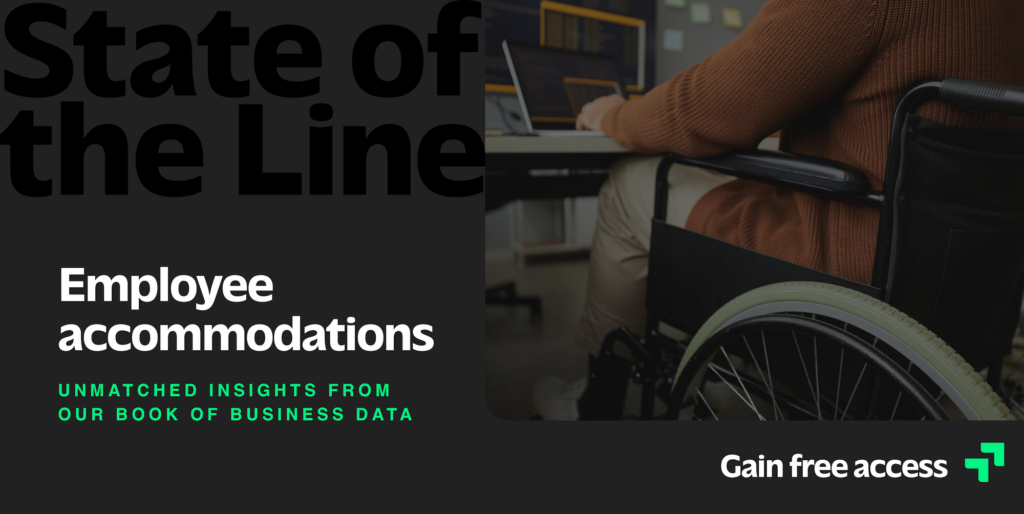
To navigate this shift, employers need more than reactive processes; they need proven best practices and clear, data-backed insight. Our 2025 State of the Line report on employee accommodations, based on one of the industry’s most expansive claims data sets, provides a benchmarked view of emerging trends, evolving patterns and operational risk. Combined with a structured, centralised approach to accommodations management, these insights help organisations move from inconsistent, ad hoc decisions to a more defensible, scalable model that improves compliance, employee experience and overall outcomes.
53%
of environmental accommodations are now WFH-related
Under the ADA and other regulations and case law, employers are required, using an interactive process and without taking on undue hardship, to make reasonable accommodations for employees — who may be transitioning back to duty following a workplace injury, seeking support for cognitive limitations, requesting an adjustment in accordance with their religious beliefs, or have various other needs. Regardless of whether the accommodation relates to a WC claim, disability or other factor, employers need sound guidance in navigating this confusing landscape.
We recently put our heads together to explore some of the current issues in workforce accommodations from both the employer and service provider perspective, and we’re pleased to share some highlights from our conversation.

The issue I see employers struggling most with is mental health. Mental health is the No. 1 claim type behind pregnancy. Employers must address this.
– David Setzkorn, SVP Compliance & Workforce Absence Practice Leader
What are the top employee accommodations challenges facing employers today?
Many U.S. organisations are struggling to keep up with requests for job accommodations and to ensure compliance with all relevant requirements. The significant challenges before today’s employers include:
- Being proactive and consistent: In recent years, some companies have sought consistency and to proactively reduce the administrative burden of accommodations by making height-adjustable desks, ergonomic chairs, large computer monitors and other frequently requested equipment standard-issue for all employees. However, the shift from on-site work to remote and hybrid arrangements has complicated that approach. What happens if the standard equipment doesn’t fit in a home workspace? Who is responsible for setup and maintenance? How is equipment retrieved if a remote employee leaves? Should hybrid workers receive two sets of equipment? These kinds of questions present real logistical issues and make cost-containment quite difficult.
- Job accommodations budgets: Whether it’s time away from work or the purchase of new equipment, there is a cost associated with job accommodations. (Some of these expenditures are legally required, while others are the right thing to do to support productivity, safety and inclusion.) Many organisations struggle with how to budget for these expenses. Should employee accommodations be considered an operational expense, or do they belong in the HR or risk management budget?
- Organized labor: It can be very tricky to implement accommodations in a union environment. For instance, schedule changes and work breaks may affect the employee’s seniority ranking — and thus anything for which they would bid under a collective bargaining agreement. Additionally, changing one union employee’s schedule or tasks as part of an accommodation may inappropriately impact those of another employee. This is proving especially tough to navigate under the Pregnant Workers Fairness Act.
What are the best employee accommodations strategies?
Recognizing that each organisation’s programme is unique, here are a few recommended approaches to accommodations management:
- Centralizing employee accommodations budgets and approval processes: While some opt to keep the costs in operations (which may discourage managers from granting accommodations), we suggest centralizing the budget for accommodations where possible. Having all accommodation requests flow through one team and funding source can help to break down internal silos between HR and risk management and facilitate more creative problem-solving. It can also result in requests being viewed with a critical eye. For instance, if someone requests new equipment, a dedicated, centralised team is more likely to consider that an ergonomic evaluation and some education on how to properly use existing equipment may suffice.
- Providing a positive employee experience: Another benefit of the centralised approach is it allows employers to keep the focus on effectively accommodating employees, rather than the cause of the injury/need. Additionally, we’re seeing a trend of employers implementing fast track options for accommodations below a certain threshold (such as $500) so employees can get their needs met more efficiently and with less hassle; limiting the need for an extensive investigation and full interactive process may also reduce overall costs to the employer. Some have expressed concern that fast tracking may increase volume, but based on anecdotal evidence, we’ve not found that to be the case.
- Implementing evidence-based processes: To help keep budgets and demand in check, we advise against providing a list of accommodation options from which employees can choose. Instead, it’s best to rely on professional recommendations and the evaluation process, as discussed above, to determine what’s appropriate and reasonable.
- Handling sensitive conversations with care: Those who work in this field know that managing accommodations can be a difficult and emotionally draining job. It may require challenging conversations with fellow employees about deeply personal matters related to their livelihood, identity and daily functioning. While our overarching goal is to empathetically support employees’ needs in the workplace, sometimes we must deny requests — and that can result in heated responses. With May being Mental Health Awareness Month, it’s especially timely to call out the importance of self-care and building resilience in processing such unpleasant interactions. Partnering with an outsourced expert vendor (like Sedgwick) can offer those responsible for accommodations in-house with much-needed support and additional resources.
Special thanks to Anne Hudson from our valued client Southwest Airlines for contributing to this article.
Learn more — Explore Sedgwick’s job accommodation solutions that help employers support employees’ needs and comply with the ADA, PWFA and other legal and regulatory requirements
Sign up for access to unmatched accommodations insights
Unlock the full experience — including free access to our 2025 State of the Line report and a follow-up email with access to a recent DMEC webinar — for even more insights.




Tags: Absence Accommodation